diff-grok - v1.3.0
Diff Grok


A lightweight TypeScript library for solving initial value problem (IVP) for ordinary differential equations (ODEs) using numerical methods. The primary solvers are LSODA — a variable-order method that automatically detects stiffness and switches between Adams (non-stiff) and BDF (stiff) formulations — and CVODE — a variable-order, variable-step solver from the SUNDIALS suite supporting both Adams and BDF methods.
Features
- Solving both stiff and non-stiff equations
- Fast computations
- Automatic stiffness-detecting method:
- LSODA - variable-order Nordsieck-based solver with automatic switching between Adams (non-stiff) and BDF (stiff) methods (Petzold, 1983; Hindmarsh, 1983). Ported to TypeScript from the C library liblsoda
- Variable-order multistep method:
- CVODE - variable-order, variable-step solver from the SUNDIALS suite with BDF (stiff) and Adams (non-stiff) modes (Hindmarsh et al., 2005; Cohen & Hindmarsh, 1996). Ported to TypeScript from SUNDIALS CVODE v7.5.0
- Implicit methods (for stiff ODEs) - Rosenbrock–Wanner type:
- Explicit methods (for non-stiff ODEs):
- Scripting:
- declarative specification of models
- auto-generated JavaScript code
- Integration with the Datagrok platform
- Zero dependencies
Installation
To install via npm:
npm install diff-grok
Minimal "Hello World" example:
// example.ts
import {ODEs, cvode} from 'diff-grok';
const task: ODEs = {
name: 'Example',
arg: {name: 't', start: 0, finish: 1, step: 0.1},
initial: [1],
func: (t: number, y: Float64Array, output: Float64Array) => {
output[0] = y[0] - t;
},
tolerance: 1e-7,
solutionColNames: ['y(t)'],
};
const solution = cvode(task);
console.log('t:', solution[0]);
console.log('y(t):', solution[1]);
Solving
General
To find numerical solution of a problem:
$$\frac{dy}{dt} = f(t, y)$$ $$y(t_{0}) = y_0$$
on the segment $[t_0, t_1]$ with the step $h$:
-
Import
ODEsand a desired numerical method:Automatic method:
lsoda- LSODA variable-order solver with automatic switching between Adams (non-stiff) and BDF (stiff)
Variable-order multistep method:
cvode- CVODE variable-order BDF solver from the SUNDIALS suite
Implicit methods (for stiff ODEs):
Explicit methods (for non-stiff ODEs) — Runge-Kutta type:
rk3- the Bogacki-Shampine 3(2) methodrk4- the Runge-Kutta-Fehlberg 4(5) methodrkdp- the Dormand-Prince 5(4) method
Explicit methods (for non-stiff ODEs) — Adams type:
ab4- the predictor-corrector method of order 4ab5- the predictor-corrector method of order 5
-
Specify
ODEsobject that defines a problem:-
name- name of a model -
arg- independent variable specification. This is in object with fields:name- name of the argument, $t$start- initial value of the argument, $t_0$finish- final value of the argument, $t_1$step- solution grid step, $h$
-
initial- initial values, $y_0$ -
func- right-hand side of the system, $f(t, y)$. This is a function(t: number, y: Float64Array, output: Float64Array) => void:t- value of independent variable $t$y- values of $y$output- output values of $f(t, y)$
-
tolerance- numerical tolerance -
solutionColNames- names of solutions, i.e. names of the vector $y$ elements
-
-
Call numerical method. It returns
Float64Array-arrays with values of an argument and approximate solutions.
Diff Grok is designed to provide fast computations. Check performance for the details.
Example
Consider the following problem:
$$\begin{cases} \frac{dx}{dt} = x + y - t \ \frac{dy}{dt} = x y + t \ x(0) = 1 \ y(0) = -1 \end{cases}$$
To solve it on the segment $[0, 2]$ with the step $0.01$ using LSODA with the tolerance $10^{-7}$, we start with imports:
import {ODEs, lsoda} from 'diff-grok';
Next, we create
const task: ODEs = {
name: 'Example', // name of your model
arg: {
name: 't', // name of the argument
start: 0, // initial value of the argument
finish: 2, // final value of the argument
step: 0.01, // solution grid step
},
initial: [1, -1], // initial values
func: (t: number, y: Float64Array, output: Float64Array) => { // right-hand side of the system
output[0] = y[0] + y[1] - t; // 1-st equation
output[1] = y[0] * y[1] + t; // 2-nd equation
},
tolerance: 1e-7, // tolerance
solutionColNames: ['x', 'y'], // names of solution functions
};
Finally, we call the specified numerical method to solve task:
const solution = lsoda(task);
Currently, solution contains:
solution[0]- values of $t$, i.e. the range $0..2$ with the step $0.01$solution[1]- values of $x(t)$ at the points of this rangesolution[2]- values of $y(t)$ at the points of the same range
Find this example in basic-use.ts.
Performance
The following classic problems are used to evaluate efficiency of Diff Grok methods:
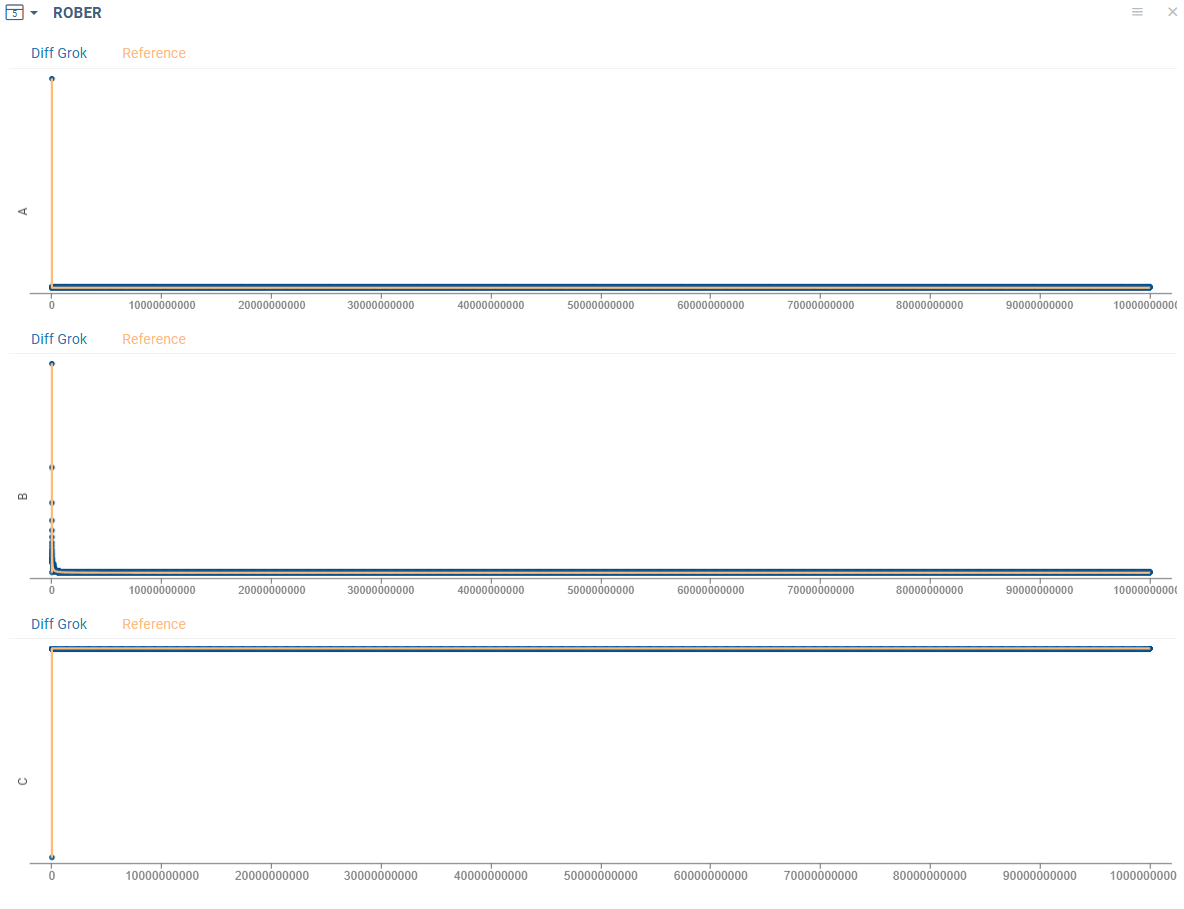
- Rober
- a stiff system of 3 nonlinear ODEs
- describes the kinetics of an autocatalytic reaction given by Robertson
- robertson.ts
- HIRES
- a stiff system of 8 non-linear equations
- explains the `High Irradiance Responses' (HIRES) of photomorphogenesis on the basis of phytochrome, by means of a chemical reaction involving eight reactants
- hires.ts
- VDPOL
- a system of 2 ODEs proposed by B. van der Pol
- describes the behaviour of nonlinear vacuum tube circuits
- vdpol.ts
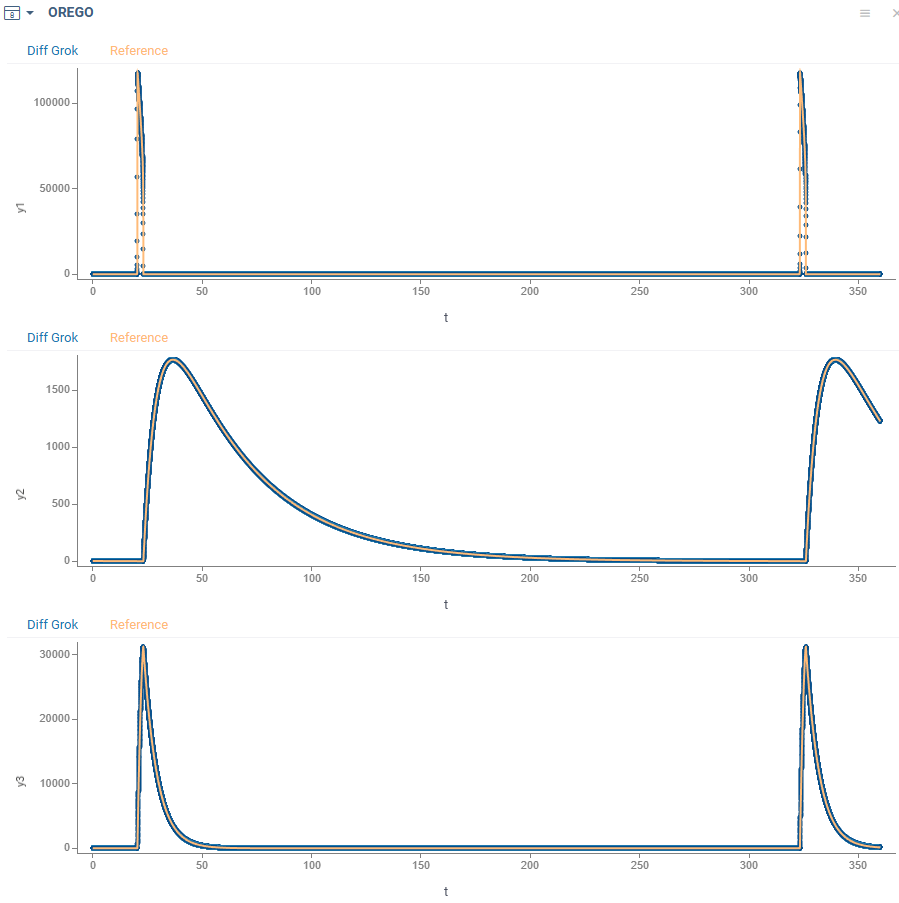
- OREGO
- a stiff system of 3 non-linear equations
- simulates Belousov-Zhabotinskii reaction
- orego.ts
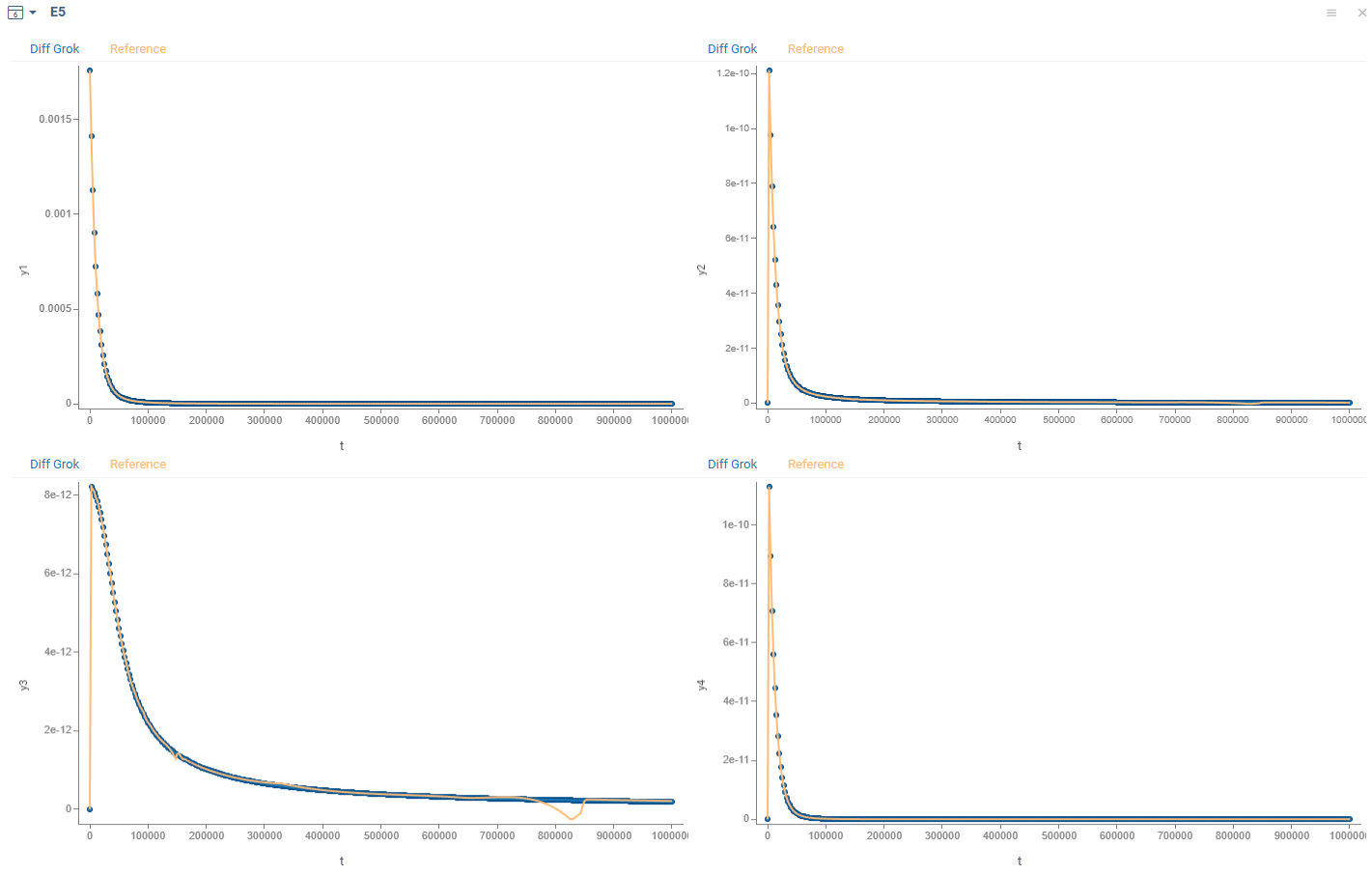
- E5
- a stiff system of 4 non-linear ODEs
- represents a chemical pyrolysis model
- e5.ts
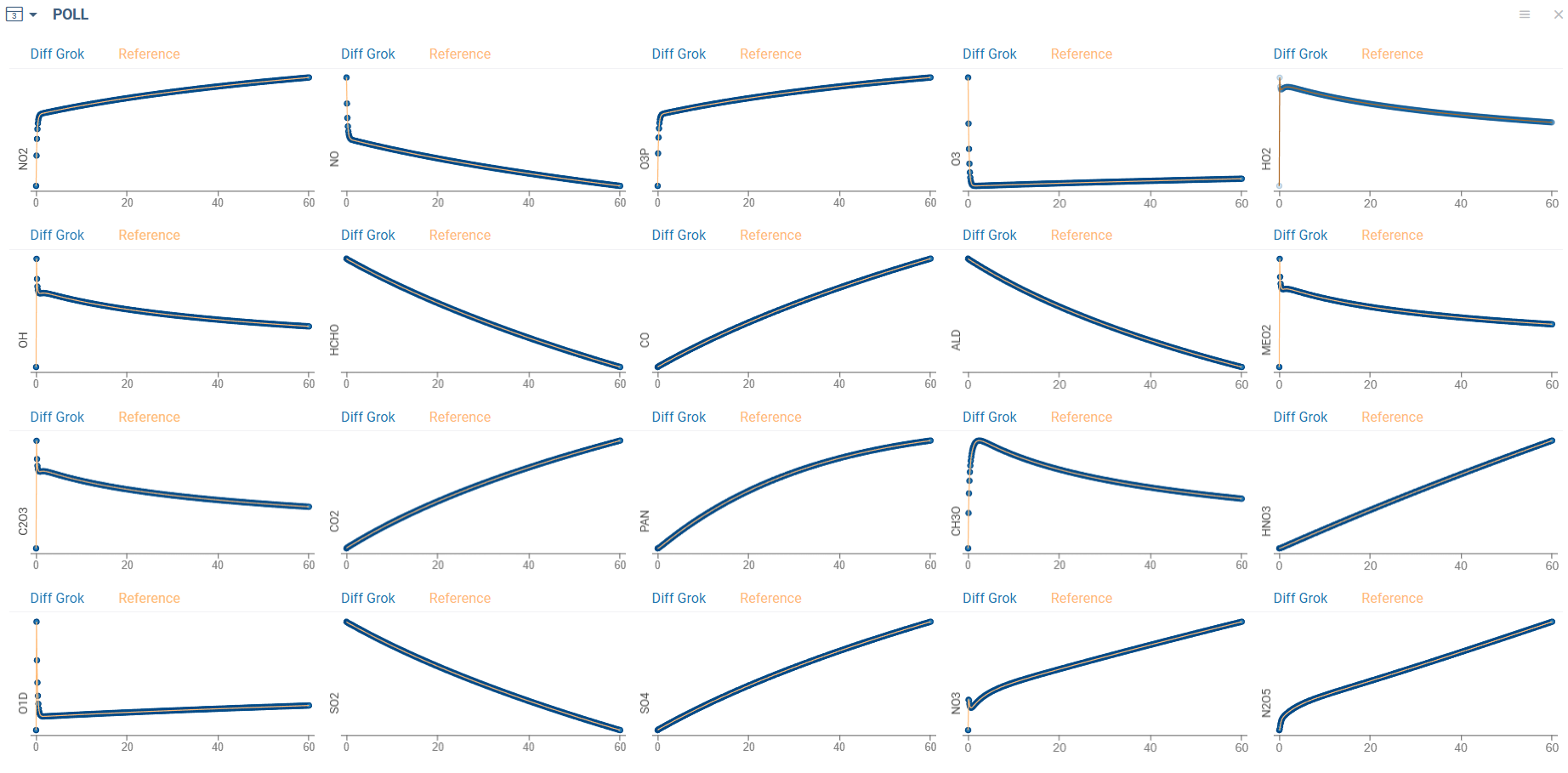
- Pollution
- a stiff system of 20 non-linear equations
- describes a chemical reaction part of the air pollution model designed at The Dutch National Institute of Public Health and Environmental Protection
- pollution.ts
The LSODA, CVODE, MRT, ROS3PRw and ROS34PRw methods demonstrate the following time performance (AMD Ryzen 5 5600H 3.30 GHz CPU):
| Problem | Segment | Points | Tolerance | LSODA, ms | CVODE, ms | MRT, ms | ROS3PRw, ms | ROS34PRw, ms |
|---|---|---|---|---|---|---|---|---|
| Rober | [0, 10E+11] | 40K | 1E-7 | 67 | 85 | 175 | 446 | 285 |
| HIRES | [0, 321.8122] | 32K | 1E-10 | 125 | 142 | 122 | 362 | 215 |
| VDPOL | [0, 2000] | 20K | 1E-12 | 268 | 352 | 492 | 1576 | 760 |
| OREGO | [0, 360] | 36K | 1E-8 | 76 | 98 | 205 | 483 | 199 |
| E5 | [0, 10E+13] | 40K | 1E-6 | 7 | * | 6 | 17 | 8 |
| Pollution | [0, 60] | 30K | 1E-6 | 12 | 15 | 18 | 50 | 23 |
* E5 is skipped for CVODE: the extremely stiff rate constants (spanning 20 orders of magnitude) cause convergence failures with the dense direct linear solver.
Maximum absolute deviations (MADs) from the reference solutions obtained using SciPy (Radau) are summarized in the table below:
| Problem | LSODA | CVODE | MRT | ROS3PRw | ROS34PRw |
|---|---|---|---|---|---|
| Rober | 1.87e-8 | 1.87e-8 | 1.87e-8 | 1.88e-8 | 1.88e-8 |
| HIRES | 1.51e-11 | 2.10e-11 | 4.80e-11 | 1.05e-14 | 2.87e-14 |
| VDPOL | 5.12e-4 | 5.12e-4 | 5.12e-4 | 5.12e-4 | 5.12e-4 |
| OREGO | 3.84e-6 | 5.20e-6 | 3.05e-5 | 3.45e-7 | 2.31e-6 |
| E5 | 3.02e-19 | * | 1.12e-19 | 1.33e-19 | 3.40e-17 |
| Pollution | 1.23e-10 | 2.15e-10 | 4.06e-10 | 9.16e-12 | 1.58e-10 |
Run check-methods.ts to reproduce these results (see here how to run scripts standalone).
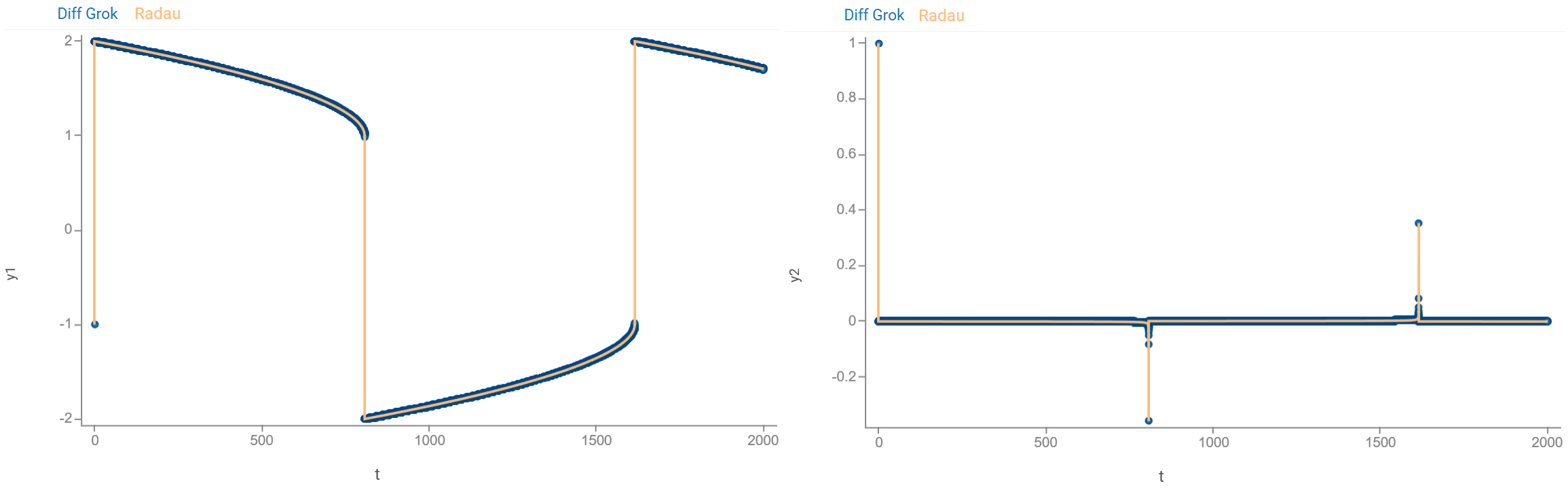
The following charts compare the Diff Grok and Radau solutions for the van der Pol system:
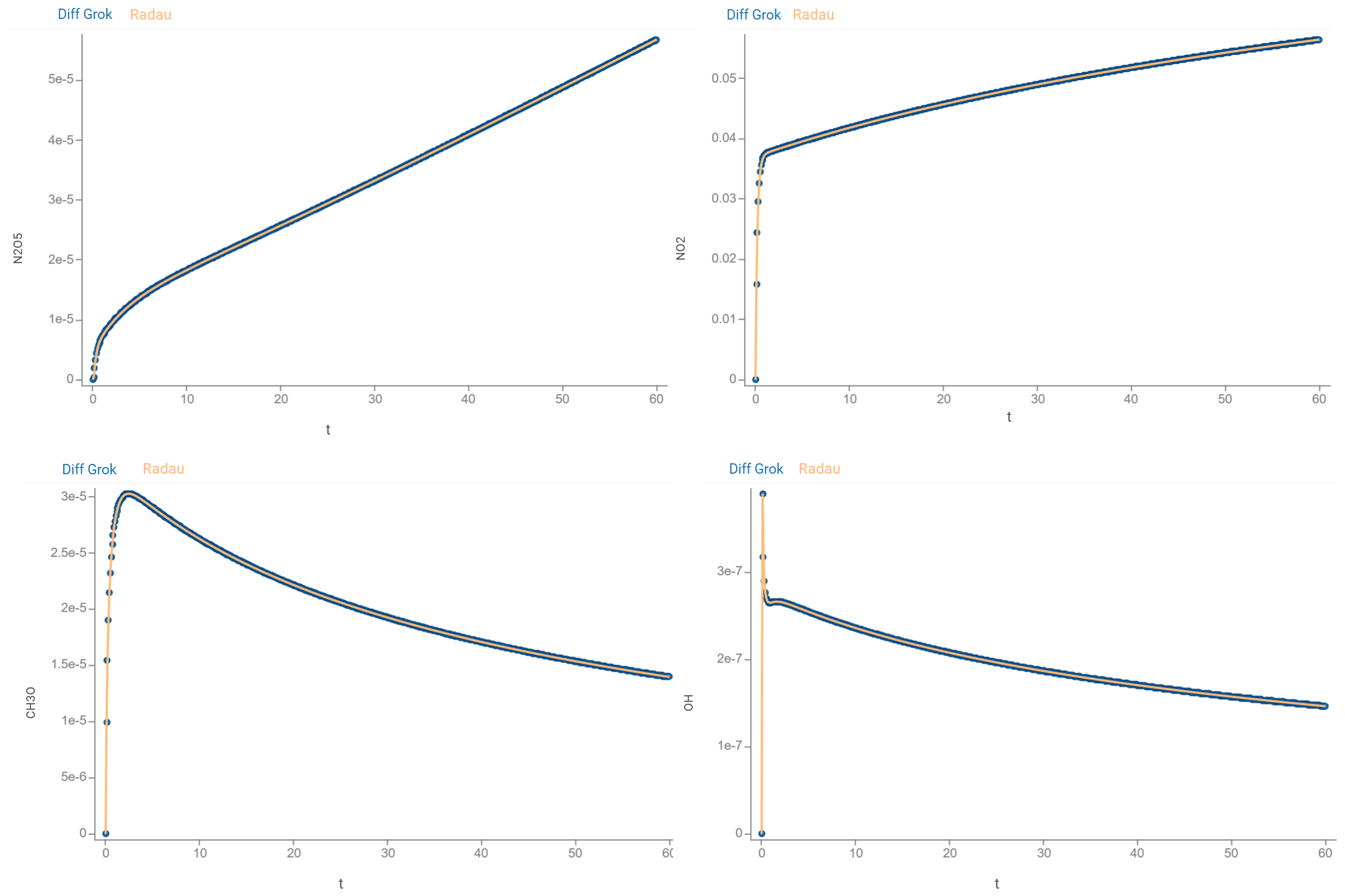
The following graphs present a comparison of the Diff Grok and Radau solutions for the Pollution model, highlighting a portion of the functions:
Gallery
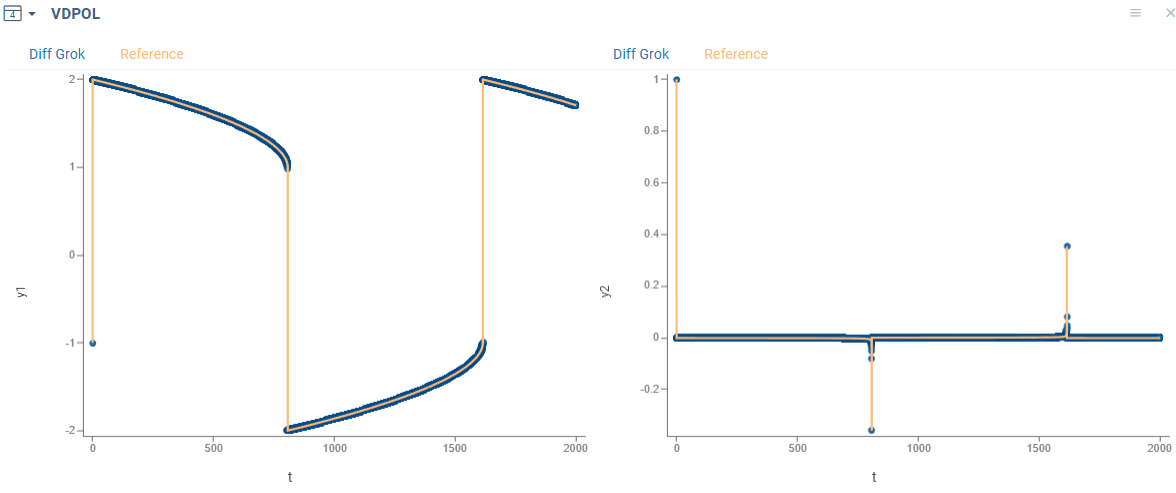
VDPOL
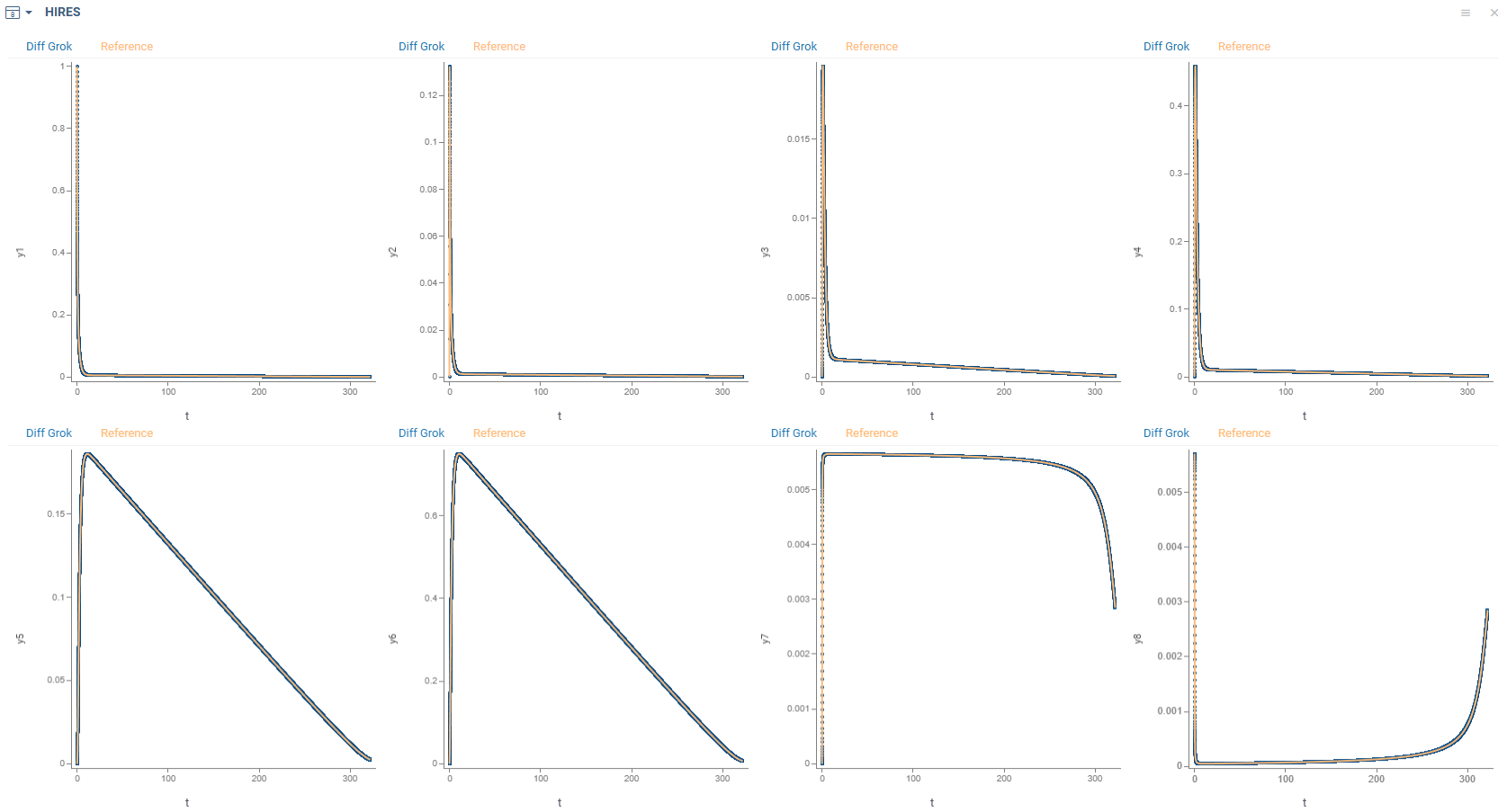
HIRES
E5
POLL
OREGO
Rober
Run benchmarks
Run benchmark models and find the reference solutions via the following links to the Datagrok platform:
| Problem | Diff Grok | Radau |
|---|---|---|
| Rober | ROBER.ivp | ROBER.csv |
| HIRES | HIRES.ivp | HIRES.csv |
| VDPOL | VDPOL.ivp | VDPOL.csv |
| OREGO | OREGO.ivp | OREGO.csv |
| E5 | E5.ivp | E5.csv |
| Pollution | POLL.ivp | POLL.csv |
In the file print-benchmark.ts, you can find standalone functions that print the solutions of these problems to the console, as well as Python scripts for computing the solutions using SciPy.
Scripting
The library provides tools for declarative specifying models defined by IVPs. This feature enables a development of "no-code" modeling tools seamlessly integrated with the Datagrok platform.
Model components and syntax
Each model has a simple declarative syntax.
Core blocks
These blocks define the basic mathematical model and are required for any model:
-
#name: Add a model identifier#name: Problem -
#equations: Define the system of ODEs to solve. Diff Grok supports any number of equations with single or multi-letter variable names#equations: dx/dt = x + y + exp(t) dy/dt = x - y - cos(t) -
#argument: Defines- independent variable
- its initial value (
initial) - final value (
final), and - grid step (
step)
The solver calculates values at each step interval across the specified [initial,final] range.
#argument: t initial = 0 final = 1 step = 0.01 -
#inits: Defines initial values for functions being solved#inits: x = 2 y = 5
Comments
-
#comment: Write a comment in any place of your model#comment: You can provide any text here. The lib ignores it. -
Place comments right in formulas using
//#equations: dx/dt = x + y + exp(t) // 1-st equation dy/dt = x - y - cos(t) // 2-nd equation
Model parameters
These blocks define values used in equations. Choose type based on intended use:
-
#parameters: Generate UI controls for model exploration#parameters: P1 = 1 P2 = -1 -
#constants: Use for fixed values in equations that don't require UI controls#constants: C1 = 1 C2 = 3
Auxiliary calculations
This block defines mathematical functions using #parameters, #constants,
#argument, and other functions. These are direct calculations (no ODEs involved). Use them to break
down complex calculations and simplify your equations.
-
#expressions#expressions: E1 = C1 * t + P1 E2 = C2 * cos(2 * t) + P2
JS-code generation
To transform any model to JavaScript code with an appropriate specification of ODEs object, follow the steps:
- Import the parsing and code generating tools:
import {getIVP, getJScode} from 'diff-grok';
- Define a string with a model specification, use a simple model syntax:
const model = `
#name: Example
#equations:
dx/dt = x + y - cos(t)
dy/dt = x - y + sin(t)
...
`;
- Parse formulas:
const ivp = getIVP(model);
The method getIVP parses formulas and returns IVP object specifying a model.
- Generate JS-code:
const lines = getJScode(ivp);
The method getJScode transforms IVP object to JavaScript code. It returns an array of strings with this code.
Find this example in scripting.ts.
Pipelines
Diff Grok pipeline is a powerful feature for complex process simulation and model analysis in webworkers. It wraps the main solver with a set of actions that perform pre- and post-processing of a model inputs & outputs. In addition, they provide an output customization.
- Start with imports:
import * as DGL from 'diff-grok';
- Define your model:
const model = `#name: My model
#equations:
dx/dt = ...
dy/dt = ...
...
#inits:
x = 2
y = 3
...
- Generate IVP-objects:
- for the main thread computations:
const ivp = DGL.getIVP(model);
- for computations in workers:
const ivpWW = DGL.getIvp2WebWorker(ivp);
- Set model inputs:
const inputs = {
x: 2,
y: 30,
...
};
- Create typed input array:
const inputVector = DGL.getInputVector(inputs, ivp);
- Get a pipeline:
const creator = DGL.getPipelineCreator(ivp);
const pipeline = creator.getPipeline(inputVector);
You can pass pipeline, ivpWW, and inputVector to webworkers.
- Apply pipeline to perform computations:
const solution = DGL.applyPipeline(pipeline, ivpWW, inputVector);
Find complete examples in these files:
- pipeline-use.ts - A basic example demonstrating pipeline usage
- model-updates.ts - A simulation of a multi-stage process using pipelines
- cyclic-model.ts - A simulation of a cyclic process using pipelines
Integration with Datagrok
Datagrok is a platform enabling powerful scientific computing capabilities. It provides next-generation environment for leveraging interactive visualizations, data access, machine learning, and enterprise features to enable developing, publishing, discovering, and using scientific applications.
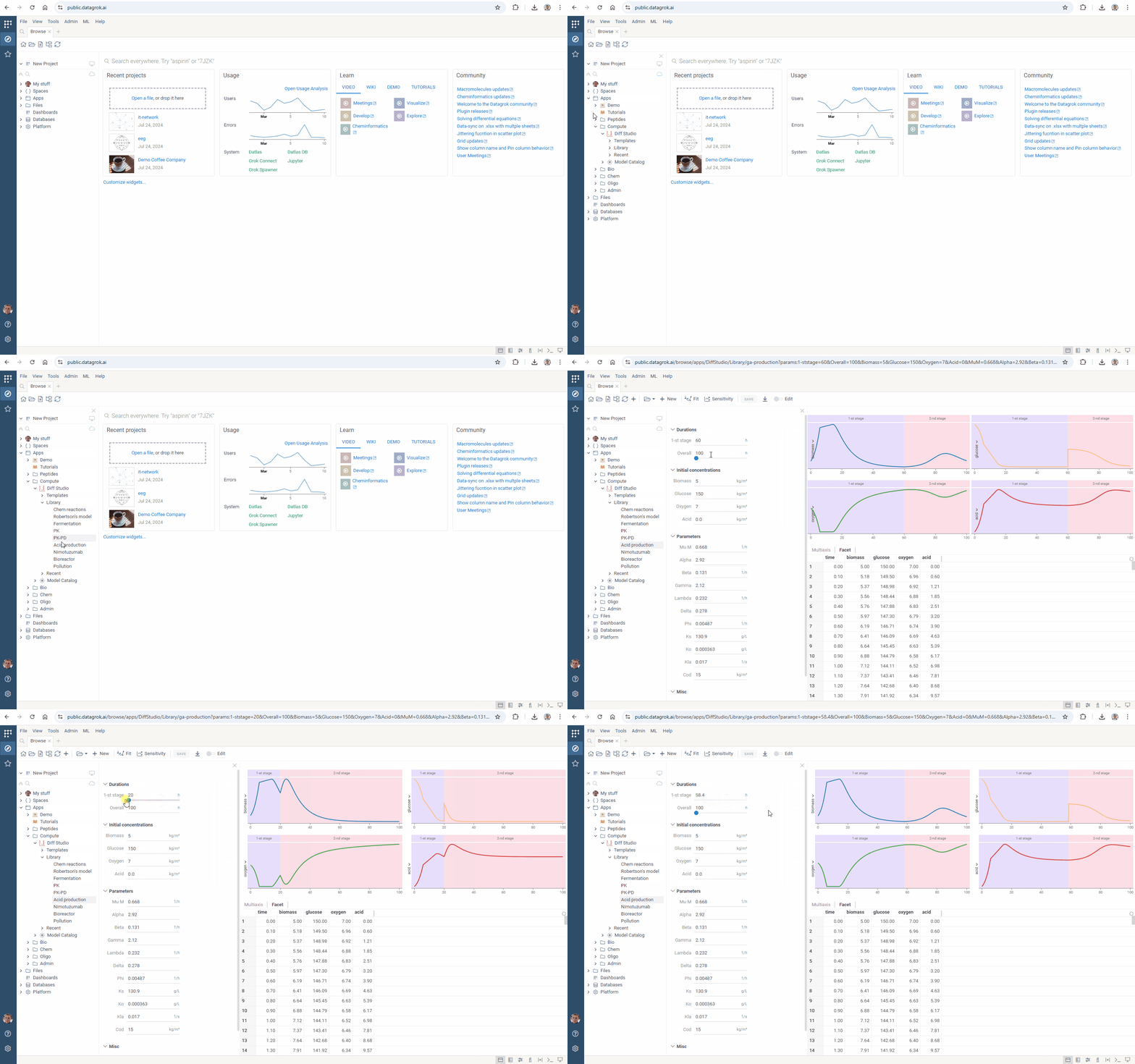
The library is seamlessly integrated to Datagrok via the Diff Studio package. It provides
- Numerical solving IVPs directly in the browser
- "No-code" models development
- Solving both stiff and non-stiff systems of ODEs
- Automatic generation of user interfaces
- Interactive visualization and model exploration
- Sensitivity analysis and parameters optimization
- Sharing models and computational results
Run the Diff Studio app and check interactive modeling:
Learn more
- Diff Studio application docs
- Diff Studio example models
- Parameters optimization
- Sensitivity analysis
LaTeX export
The latex-export module converts IVP model files into publication-ready LaTeX and Markdown with LaTeX math:
import {convertIvpToLatex} from 'diff-grok';
const ivp = `#name: Robertson
#equations:
dA/dt = -0.04 * A + 1e4 * B * C
dB/dt = 0.04 * A - 1e4 * B * C - 3e7 * B**2
dC/dt = 3e7 * B**2
#inits:
A = 1 {units: mol/L}
B = 0 {units: mol/L}
C = 0 {units: mol/L}
#argument: t
start = 0
finish = 40
step = 0.01`;
// LaTeX output (default)
const latex = convertIvpToLatex(ivp);
// Markdown output
const markdown = convertIvpToLatex(ivp, {format: 'markdown'});
See the full documentation in src/latex-export/README.md.
Environment Requirements
Development & Build
- Node.js ≥ 19.3.0 (required for development and building the library)
- npm or yarn package manager
Runtime Environments
Server-Side (Node.js)
- Node.js ≥ 16.0.0 (for server-side usage)
- Requires support for ES modules
Float64Arrayand typed arrays support (available since Node.js 0.10+)
Operating Systems
- Windows (x64, ARM64)
- macOS (Intel & Apple Silicon)
- Linux (most common distributions)
Browser Support
The library runs in all modern browsers with ES2022+ support (matching tsconfig.json: target: "es2022", module: "es2022", lib: ["ES2022", "dom"]). Key requirements:
- ES2022 JavaScript support
- ES Modules (native
import/export) - Typed Arrays (
Float64Array,Uint8Array) - WebWorkers (for pipeline computations)
- ArrayBuffer support
| Browser | Minimum Version | Supported? | Notes |
|---|---|---|---|
| Chrome | 63+ | ✔️ Yes | Full ES2015+ and WebWorker support |
| Firefox | 60+ | ✔️ Yes | Full ES2015+ and WebWorker support |
| Safari (macOS/iOS) | 11.1+ | ✔️ Yes | Native ES module and WebWorker support |
| Edge (Chromium) | 79+ | ✔️ Yes | Same support level as Chrome |
| Opera | 50+ | ✔️ Yes | Chromium-based, full support |
| Legacy Browsers | - | ❌ No | IE 11, pre-Chromium Edge, old Android browsers |
Browser Feature Requirements:
- ES2022 JavaScript support
- Native ES modules (
<script type="module">) Float64Arrayand other typed arraysWebWorkerAPI (for parallel computations)PromisesupportMathobject with standard functions (exp,sin,cos, etc.)
Notes:
- For older browsers, consider using a transpiler (Babel) and bundler (Webpack/Rollup)
- TypeScript compilation target should be ES2022 or higher (or transpile down for older browsers)
- WebWorker support is required for pipeline computations; without it, computations run on the main thread
Bundler Configuration
When bundling for browsers, ensure:
- ES module output format is preserved or properly transformed
- TypedArray polyfills are not included (not needed for target browsers)
- WebWorker files are properly handled by your bundler
Polyfills
No polyfills required for target environments. All required features are natively supported in the minimum browser versions listed above.
Examples
Diff Grok contains a set of examples located in the folder src/examples:
| File | Features |
|---|---|
| basic-use.ts | Minimal "Hello World" example. Illustrates the use of the MRT method. |
| check-methods.ts | Checks the performance of numerical methods. |
| corr-probs.ts | Solves a set of problems with exact solutions and evaluate the deviation. |
| cyclic-model.ts | Considers pharmacokinetic-pharmacodynamic (PK-PD) simulation and shows how to apply pipelines and cyclic models. |
| model-updates.ts | Considers gluconic acid (GA) production by Aspergillus niger modeling and shows how to apply pipelines and models with updates. |
| pipeline-use.ts | Considers modeling queues and shows shows how to apply pipelines and models with customized outputs. |
| scripting.ts | Shows how to generate JS-script from Diff Grok model. |
Run examples
To run examples standalone:
- Install TypeScript locally. If your project does not already include TypeScript:
npm install --save-dev typescript
- Create a tsconfig.json. If you do not have one yet:
npx tsc --init
Recommended configuration:
{
"compilerOptions": {
"target": "es6",
"lib": ["ES2022", "dom"],
"sourceMap": true,
"strict": true,
"moduleResolution": "node",
"types": ["jest", "node"],
"esModuleInterop": true,
"skipLibCheck": true,
}
}
- Compile the TypeScript file:
tsc src/examples/basic-use.ts
- Run:
node src/examples/basic-use.js
References
- L. Petzold, "Automatic Selection of Methods for Solving Stiff and Nonstiff Systems of Ordinary Differential Equations," SIAM J. Sci. Stat. Comput., 4(1), 136–148, 1983. doi:10.1137/0904010
- A. C. Hindmarsh, "ODEPACK, A Systematized Collection of ODE Solvers," Scientific Computing, R. S. Stepleman et al. (eds.), North-Holland, Amsterdam, pp. 55–64, 1983. link
- The LSODA solver is ported to TypeScript from the C library liblsoda
- A. C. Hindmarsh et al., "SUNDIALS: Suite of Nonlinear and Differential/Algebraic Equation Solvers," ACM Trans. Math. Softw., 31(3), 363–396, 2005. doi:10.1145/1089014.1089020
- S. D. Cohen and A. C. Hindmarsh, "CVODE, a Stiff/Nonstiff ODE Solver in C," Computers in Physics, 10(2), 138–143, 1996. doi:10.1063/1.4822377
- The CVODE solver is ported to TypeScript from SUNDIALS CVODE v7.5.0
- T. Rang and L. Angermann, "New Rosenbrock W-Methods of Order 3 for Partial Differential Algebraic Equations of Index 1," BIT Numer. Math., 45, 761–787, 2005. doi:10.1007/s10543-005-0035-y
- E. Hairer and G. Wanner, Solving Ordinary Differential Equations II: Stiff and Differential-Algebraic Problems, Springer, 1996. doi:10.1137/S1064827594276424
Contributing
We welcome contributions of all kinds - bug reports, feature requests, documentation updates, and pull requests.
Before contributing, please read our Contributing Guidelines.
License
This project is licensed under the MIT License.
The LSODA solver is a TypeScript port of liblsoda. The CVODE solver is a TypeScript port of SUNDIALS CVODE. See THIRD_PARTY_LICENSES for details on third-party code provenance.